Monday, 30 July 2012

Negative splits and hockey sticks

Well after all the hype and build up, the Olympics are finally here, and so far, they have not disappointed me. All the sport on this week has been able to distract me from thinking too much about our sub-standard showing on Saturday. You could dissect each element and look for what exactly went wrong, but fundamentally, we were well beaten by a better team.
                This weekend we have a chance to right some of those wrongs by offering up an improved performance against another of the title challengers, Nottinghamshire Academy. They will no doubt provide us with a stern test, but often it is easier to follow a poor performance with a big game as it forces you to raise your performance levels even more.
                In watching the sports-fest that is London 2012, I have decided to look to see what ideas, approaches or tactics could be applied from other disciplines to improve performances in my own chosen sports. As a hockey enthusiast, I have been delighted to see the sport getting a good TV billing, and I recommend you to tune in for a GB match this week where you can expect to see a fast paced, entertaining and highly skilful game.
                What has really caught my eye so far though, and is something that I first heard while watching the Tour de France last week, is the concept of ‘negative split’ times in cycling, swimming and running. The principle is simple. You want to try and go faster in the second half of the race or time trial than you did in your first. In essence, it is a simple concept, and one that I am sure many athletes and cyclist have done before. However, it is something that Bradley Wiggins swears by and has become an important part of his success as a rider. The key is this, you need to find a pace in the first half of the race which places you towards the top of the leaderboard, but then have the ability to surpass that pace in the second half of the race to accelerate, not decelerate to the finish.

Daily Telegraph (c) - Bradley Wiggins is the perfect exponent of the 'negative split'
           
              In cricketing terms, it is exactly what Cuckney did to us on Saturday when batting, and in doing so blew us right out of the water by tea. As a result, we then felt we had to go at a fast pace in the first half of our innings (time trial), and in doing so we burnt ourselves out! The art of chasing a score should be the same as winning a time trial. You need to be in it at half way. Sometimes that might mean being close to the split time of your opponent at the midpoint, but if you know you can go fast at the end, it is not always the case that you need to be following the course of their innings.
                I also see this mentality applying to a bowling mind set too. Why should we not try as a fielding side to restrict the batting team to fewer runs in the second half of their innings than the first? OK, so they might have wickets in hand and bat with fewer inhibitions against a softer ball, but if we can aspire to keep them to less in the second half, and in doing so produce our own negative split, it might just help keep our focus in those difficult final 15 overs when attention and discipline can sometimes wane.
                It can also work on an individual basis. Why not try to bowl tighter in your last five overs than your first or try to score you next twenty runs in fewer balls than the last. It is just the case of focusing the mind on the task at hand while keeping your eye on the broader situation of the game.
                Hopefully we can respond it the right way this weekend and I will be able to travel down to the Olympic Park, for my own taste of the games on Monday, with a smile on my face and 20pts in the back pocket.

Tuesday, 24 July 2012

Sing when you’re winning…

This weekend is a huge one for us at Kimberley. We have been talking about it for quite some time and much preparation has already gone in to how we are going to execute our plan. That’s right, it’s the fancy dress karaoke. Before that though, we have a rather important game of cricket too! Cuckney have had a sensational start to the season. They have played the best cricket, and are very much worth their place at the head of the standings. After all, a table never really lies (although I am sure the Cavalliers would probably disagree!).
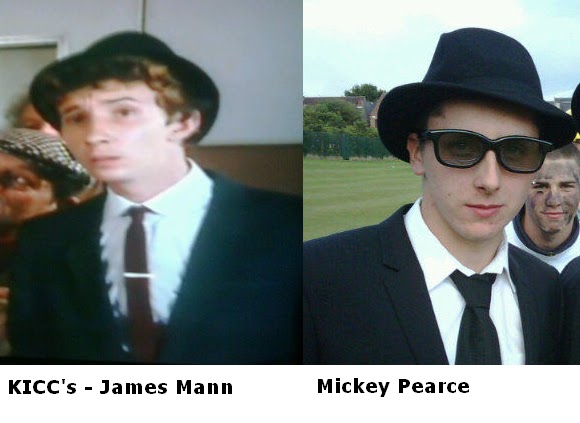
James Mann won first prize at last years Mickey Pearce look-a-like fancy dress

                It is going to be a tough test for us, but one that we know we have the ability to meet, and it will come down to individuals taking responsibility for their own game, and not becoming reliant on others to score the runs or take the wickets for them. A win would keep us in the hunt at the top of the table, a defeat would leave us a long way back.
                Although we missed out on league action on Saturday, it was nice to get a run out on Sunday in the Derbyshire Cup. Once again, we performed well as a unit in the field and it was great to bowl Dunstall out for just 68. Matt Wright and Dom Wheatley bowled exceptionally well up front for us and gave us a great platform to win the game. I have been delighted to see how Dom has stepped up his performances this season. With Simon Roberts still struggling with injury, the weight of opening the bowling has fallen on his young shoulders and he has taken to the challenge superbly. It was noticeable on Sunday how much more intelligent he is, as a bowler, and how he is starting to learn and master the craft of left arm swing bowling. It is no doubt a huge advantage to him to have Sam standing up to the stumps, and no batsman can be confident in their footwork when the ball beats the bat.
                The Derbyshire Cup has benefited I feel from a move to straight knock-out form. It seemed ludicrous last season to be eliminated from the competition after winning our only game. The finality of knock-out matches means that players can concentrate on winning the game at hand and not worry about run-rates and mathematical calculations. With a place in the semi finals booked, we have a date in August to look forward to, but we all know that without a positive result this weekend, the second half of the season in the league will be a tough slog if we are not in contention. One thing is for sure, we will all look forward to the party afterwards to see Colin Martin singing ‘Return to Sender’ something he was unable to manage last year.

Wednesday, 18 July 2012

Poznan celebrations, supersoppers and a mangle…The new cricket!

I am writing this article three days into a hectic school cricket tour in Lancashire. While it has been very tiring trying to keep up with the boundless energy of the kids, it has been ultimately rewarding and continues to remind me of the importance of tours and educational visits in developing not only young cricketers, but good young people.
On Monday night we took the boy’s to the revamped Old Trafford in Manchester. Yes, as expected it rained, and by 8 o’clock it looked like the two and half overs managed at 6pm were all we were going to see. The umpires preserved (maybe with a bit of arm twisting from the present Sky Sports producers), and so did we, and our boys were rewarded with an entertaining 16 over match in which Lancashire, the side batting second, prevailed. Admittedly, the focus of our 12 and 13 year olds lads was less on the techniques of Shazad or Croft, and more on how much silly dancing, and an impromptu impersonation of the Manchester City fans Poznan celebration, could draw the attention of the TV cameras. However, it did demonstrate the importance that getting a game of cricket on at all costs can be worth it, particularly in the professional game when crowds have paid to be entertained.
Kimberley can be extremely proud of the way in which the ground staff and players come together to get a cricket match on. Once again on Saturday, the rain looked like it may intervene, just as our run chase was starting to get into gear. However, with a little help from some sponges, a mangle, various pieces of astroturf, a supersopper, a roll of coconut matting, and the work of about 20 people, the game restarted and Akhil Patel superbly guided us to victory.
It was also pleasing to see Paldeep Sidhu play a crucial supporting role to Akhil in knocking off the runs. Sidhu has worked very hard on his game this year to get himself into form, and his requests for specific preparation on Thursday at nets clearly paid off. It was nice to see a young player, thinking about his game, and the likely threats faced at the weekend, and preparing accordingly. I have also done this for this Saturday. I have been to ASDA to buy an umbrella and a pair of wellies. See you at Caythorpe!

Tuesday, 10 July 2012

50 Shades of Grey Sky...

Once again the weather has continued to thwart all reasonable attempts to play any cricket in Nottinghamshire. Last weekend, all but one of the Premier League matches was cancelled without a ball being bowled, and the only game that saw some action, Cuckney versus Worksop, failed to reach a full conclusion.
A lot has been said on this weather, but I really can’t remember a season or summer quite like this one. I think one of the elements that has been so destructive to our cricket season is when it has rained, just as much as the quantity of rain. So many times this year we have seen the heaviest rain fall on Thursday, Friday and Saturday, rather than during the earlier part of the week. This has left the grounds with no time in which to soak in the excessive precipitation.
With little to discuss on events at Kimberley, the cricketing week has been defined for me by two events. Firstly, we have seen the retirement of Mark Ramprakash, a great servant of English cricket, who despite his perceived weaknesses at the top level, finished with a record in First Class cricket few could match. Ramprakash’s passing from the First Class game, has been deemed to be a watershed moment for many, as one of the last few remaining relics of the trying period of English cricket through the 1990s. For me though, Ramprakash will be fondly remembered as a battler. In an era now of high strike rates, powerful hitters, and innovative shots, there is less and less need or desire for his type of player, who valued their wicket, stuck to their best shots, and were happy for the team to score at 2 runs per over. Coaches and Captains when faced with a difficult wicket nowadays, are much happier to see their players go down blazing, with the mantra of ‘get what you can while you can’, rather than the Ramprakash method of ‘bat and hope it gets easier’. There is no doubt that many cricketing observers, and probably Ramprakash himself, will feel that there is a gaping hole in the centre of his career where a barrel full of international runs should lie, but to score one hundred first class hundreds, he can go away knowing that he entertained and fulfilled many people, at least on a domestic level.
Guardian (C) - Mark Ramprakash has always been a battler

The second event that has caught my eye this week was the Finals Day of our own Nottinghamshire Twenty20 competition. It was great to see a former Kimberley man, Nick Langford, scoring a crucial 56 in the final to steer Cuckney to victory. Langers is a good friend, and was someone who warmly welcomed me into the club last year, so I am delighted to see him doing so well. Indeed, or duet rendition of ‘When the Going Get’s Tough’ at last year’s karaoke is still talked about in many parts of Kimberley.
Nick Langford is having a great season

 I do still think that the League Twenty20 is a missed opportunity. We currently play one qualifying day on a Sunday in June, where you play in a group of four with two semi-finals and a final. When I played at Lancaster, the Twenty20 format was developed quickly into a coloured kits, Friday evening bonanza. Music blared, the crowds poured in, the clubs made a little money, and the players enjoyed the change and excitement. If we replicated it by having three groups of four, who play in a mini league and the winner qualifies for the finals day (still keeping the space for the South Notts/Bassetlaw winner), the competition could be enlivened and differentiated. A sponsor for the coloured kits is out there, we just need to find them!

Tuesday, 3 July 2012

Chalking up the points

This weekend looked a very tough one on paper, Saturday’s league match against the big spending West Indian Cavalliers followed by a tricky Derbyshire Cup First Round tie against Spondon on Sunday. In the end, both games proved be relatively straight forward, with an emphatic six wicket win against ‘the Cavs’ on Saturday followed by a comprehensive 62 run victory over Spondon.
While Sunday’s victory was extremely pleasing and will hopefully be the start of a good cup run through the second half of the season, it was Saturday’s result that will have sent shockwaves around the league circuit.
West Indian Cavalliers boasting seven players with first class experience, two of whom are former Test stars, arrived at Newdigate Street expecting a tough contest from a Kimberley side who had famously turned them over on the same ground a year before. They were not, however, quite ready for the exceptional spell of bowling that Matt Wright delivered, ably supported by Dominic Wheatley and Richard Adams, to dismiss them for a paltry 63. Wright’s control of length and line was just too good for the experienced opposition line up, and was a perfect example of how to go about taking wickets on a pitch which offers you just a little a bit of assistance. He did not go chasing wickets, but stuck to his disciplines, keeping the ball in area which made it hard to score, and in doing so forced many batsmen in to taking a risk which proved very costly. I was delighted for Matt, although it now looks an uphill battle in our personal duel to finish with the best average!
One of the big disappointments of the day was an incident during our run chase. After losing Dan Birch early on, Akhil Patel and Jon Terry put together a very useful partnership to take the score to 31-1 before Saqlain Mushtaq came into the attack. The former Pakistan Test ace, was quick to make an impact dismissing Patel who pushed and missed at one outside off stump. Mushtaq had already come to the attention of the observant crowd before his first delivery however, as he had a strange white substance covering his hands. With a nose that senses a bit of wrongdoing, new batsman Orgizovic asked the umpires to take a look at what was going on. After a discussion between them, and with the bowler, the mystery substance which was being topped up from the left pocket was no longer being applied.
Chalk is often used by gymnasts to help with grip...and scurvy


I decided to enquire with the umpires after our victory, just what was going on. They informed me that Saqlain had been wearing chalk on his hands to treat a skin condition he has. Being someone who is always keen to learn about medical treatments, I have been scouring the internet to try and find the medicinal benefits of chalk for the skin. Unfortunately so far I have drawn a blank, although it was used to treat scurvy in the Middle Ages. I did however, find it was very good for drying out the hands and materials to assist with grip. Still it was pleasing we chalked off the runs and can look forward to a trip to Plumtree this week. It is important we keep chalking up the points through July if we are to stay in contention at the right end of the table. Weather permitting of course!

Tuesday, 26 June 2012

John fought the law and the law won!

Monday proved to be quite a struggle for me after the exertions of a hectic weekend. On Friday night, I travelled up to Manchester to see Bruce Springsteen rock the City of Manchester Stadium. ‘The Boss’ put on quite a show, and despite the seasonal Lancashire weather (heavy rain pouring for sections of the performance), Springsteen and his E Street Band played non-stop for over three and half hours. Not once did I see, the drummer come out with a brolly looking up towards the clouds, nor did Springsteen whip out a light meter. They played to entertain the crowd, something the ICC seem to forget when players walk off with full houses and the flood lights on.
Saturday saw us play a great game of cricket up at Welbeck, where we pleasingly took the larger portion of the points in a hard fought draw. The match was dramatized by one very unusual incident in the later stages of the home sides run chase. Guy Darwin struck the ball out to the mid wicket boundary where the ball seemed to be destined for six. John Terry, the fielder in closest proximity started to move off the pitch ready to collect the ball when he realised it has started to hold up in the powerful breeze. From his position just off the pitch, Terry leapt forward, caught the ball in the air, and landed safely a yard inside the rope. Everyone celebrated the wicket, and the batsman started to walk off. The umpires however, were not convinced. After some discussion, they informed us that it was not out as Terry had started just outside the pitch. “So its six then?” Asked a disappointed Kimberley Captain. “No” came the reply. In the end, the ball resulted not in a wicket, or in a six, but with one run awarded to the batting team. This was even more confusing as the batsmen had not even run the single!
It was an unusual situation, and one that has split opinion with the different people I have asked. Some suggested that if he had started outside the pitch then it should have been six, others though argued, how is that any different to a player who catches the ball, throws it in the air before toppling over the rope, then runs back in to catch it before it lands.
Sarah Ansell (c) - Mind those feet! Joe Denly takes a boundary catch

After looking online at the Law Book I was pleased to see that the umpires had got the initial decision spot on following a law clarification issued in 2010. Law 19 point 4 states, For it to be out, ‘the first contact with the ball is by a fielder either with some part of his person grounded within the boundary, or whose final contact with the ground before touching the ball was within the boundary’. I decided to then check to see if it should have been a six. Again, the umpires had it spot on that the ball was not six. So it appears John’s antics have found a loophole in the laws of the game! In my opinion, the correct decision on Saturday would have been bizarrely a dot ball, as no runs had been scored and no wickets taken. I just wonder if this is the last time we hear of John Terry in breach of the law in the coming weeks.
My hectic weekend was completed on Sunday when I drove up to my old school in Lancaster to play in an Old Boys game as part of the opening of the new revamped, Douglas Cameron Pavilion. Douglas has been involved with cricket at Lancaster RGS for nearly 60 years, starting at the school as a teacher in the 1950s and continuing his involvement since retiring in 1991 up to the present day. Doug is an remarkable example to us all of dedication to the development of young players, and to him I am eternally thankful for the positive way he influenced my game. Long may your contributions continue Doug, and if there were only a few more of your kind, we might just have some stronger school cricket within the state sector.

Tuesday, 19 June 2012

Are you proactive or reactive?

Saturday was another frustrating day for us. Once again we had to battle against the conditions to try to get a match in. I have never known a season quite as bad as this one, with the number of games and overs that have been lost to rain. It was only through the remarkable work of our groundstaff, led by the diligent and devoted Stewart Burrows, that we were able to get any play in at all on Saturday. Our frustration was then compounded by the fact that once Sam had managed to negotiate getting the game on, we then fought our way into a strong position only to be dashed by the weather again.
It was nice to get a good bowl, and I always relish bowling towards the end of an innings when batsman are trying to come hard at you. It gives you a real challenge, and puts the pressure on you as a bowler to hit your lengths and perform. It also places the emphasis on you to try and be proactive, and win the mind battle over the batsman. Too many times in the later stages of a game, you see the Captain move the fielder where the ball has just gone. This kind of reactive response, is not necessarily wrong, given that it is shrewd to avoid a player scoring in the same zone again, but as cricketers we need to be intelligent and look for the clues as to where the batsman will hit the ball before it goes there.
After being hit for a four on the third ball of the last over, I wanted to ‘react’ and come around the wicket after bowling the previous balls over the wicket. I was pleased that Sam intervened and reminded me that so far I had won the battle and that has been a one off. I carried on over the wicket, adjusted my line and length, and managed to get the stumping.
This ‘reactive’ situation crops up most for slow bowlers when it comes to where to position your mid off and mid on, and when to drop them back. I often here this phrase ‘lets see if he goes first’. But should we wait until he clears them before you drop them back? I would argue that more often than not, a lifted straight drive is an impulse shot based on length and flight of the ball. Most batsman have the confidence they will reach the boundary, so whether they are back or not they are happy to take the risk. It can be very frustrating as a batsman seeing a ball go over mid on or mid off for a one bounce four. Often the first can be a sighter, and mishit which is the best or only chance to take your wicket. Yes, we don’t want to give easy singles to mid off, but very few league cricketers have the patience of skill to continually milk this area.
Getting the man in deep right can be the difference between 6 runs or a wicket

As a bowler, to be proactive, you need to look for the clues. How are they holding the bat, which shots have they played so far? If they haven’t looked to sweep, why have a man on the sweep? Do they keep eyeing up a particular part of the pitch? Is one batsman looking to go hard, and one looking to work singles? All of these factors should be running through your mind to help you set your field and shape your approach.
The same can be said for batsmen too. One thing that players are now often coached is to try and look for a boundary off the first ball of the over. Why? Well this puts all the pressure onto the bowler. As a batsman, are you proactive in getting the opposition to set the field that you want, or are you reactive and thus constrained by the field they set? Calculated risk taking can open up your favourite shot to enable you to milk easy runs.
As the season progresses, and we move into a crunch phase of the year, it is important that we continue to be a proactive as possible with our cricket and try be smart with everything we do. If we can master that balance, we still have a good chance of being in the mix at the right end of the table.
STOP PRESS
It would be untoward not to express my sadness for the events of the last week. My thoughts are with the Maynard family and those of the children hit by the tree at the club in London.